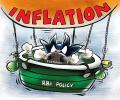
The Reserve Bank of India (RBI) has projected retail inflation at 4.2 percent for the next financial year beginning April while retaining the forecast for 2024-25 at 4.8 percent. The central bank attributed the expected easing of inflation to good kharif production, winter-easing in vegetable prices and favorable rabi crop prospects. However, the RBI also noted that continued uncertainty in global financial markets coupled with volatility in energy prices and adverse weather events presents upside risks to the inflation trajectory.

The Reserve Bank of India (RBI) is expected to cut interest rates for the first time in nearly five years in Governor Sanjay Malhotra's first monetary policy committee (MPC) meeting on Wednesday. The meeting of the six-member MPC, which will culminate on Friday, aims to boost sluggish economic growth, which is seen falling to a four-year low. Malhotra took charge as the 26th RBI governor in December last year.

Sanjay Malhotra takes charge as the 26th RBI governor at a time when headline retail inflation has shot up to 6.2%.
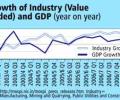
The case for a swift and sizable reduction in the repo rate rests on several pillars. First, and most importantly, there is mounting evidence that the five-year old surge in India's economic growth, especially industrial growth, peaked a few months back.

'If it doesn't, it will continue with measures to infuse liquidity, signalling a new cycle,' predicts Tamal Bandyopadhyay.

The Asian Development Bank (ADB) has revised down India's GDP growth forecast for fiscal year 2026-27 (FY27) to 6.6 per cent from an earlier 6.9 per cent, primarily attributing the change to elevated energy prices stemming from the Middle East conflict. Despite this moderation, India is still expected to remain the world's fastest-growing major economy.

The Reserve Bank is unlikely to cut the benchmark interest rate in its forthcoming bi-monthly monetary policy review later in the week as retail inflation is still a cause of concern, and there is a possibility of the Middle East crisis deteriorating further, impacting crude oil and commodity prices, say experts.
'Growth, liquidity and deposit mobilisation are likely to be discussed during the interaction.'

The Reserve Bank's rate-setting panel began its three-day deliberations on Monday to decide the next monetary policy amid expectations that the central bank will maintain status quo on the benchmark interest rate in the backdrop of global scare due to the new coronavirus variant Omicron. Reserve Bank Governor Shaktikanta Das headed six-member Monetary Policy Committee (MPC) is scheduled to announce the policy resolution on Wednesday. If the RBI maintains status quo in policy rates on Wednesday, it would be the ninth consecutive time since the rate remains unchanged.

The Reserve Bank of India's (RBI's) job to bring down inflation is not over, and any premature move on the policy front could undermine the success achieved so far on the price situation, according to RBI Governor Shaktikanta Das. RBI's rate setting panel, Monetary Policy Committee (MPC), had met for three days from February 6-8. The panel decided to leave the key policy rate unchanged at 6.5 per cent for the sixth time in row.

'We have seen that stablecoins lack the basic attributes of money, their advantages are neither unique nor unambiguous and their risks are all too real.'

Moody's Ratings on Tuesday said tax cuts in the current fiscal has dented India's revenue growth, leaving less scope for fiscal policy support for the economy.

India's wholesale price inflation surged to 3.88 per cent in March, marking the fifth consecutive monthly increase, primarily driven by a sharp rise in crude petroleum, natural gas, and manufactured items amidst the West Asia crisis.

The Asian Development Bank (ADB) on Wednesday lowered India's growth forecast for FY26 to 6.5 per cent from 6.7 per cent on account of trade uncertainty and higher US tariffs that are expected to impact exports and investment. Despite the downward revision from the April 2025 Asian Development Outlook (ADO), India remains one of the fastest-growing major economies in the world.

Volatility is likely to continue in the stock market this week amid Omicron uncertainty and the RBI monetary policy meeting will be a key driver for benchmark indices going ahead, say analysts. It will be an event-packed week for the markets, with RBI policy and several macroeconomic numbers scheduled to be announced, they added. "Volatility is likely to continue amid Omicron uncertainty, RBI credit policy, and macroeconomic numbers. "There are lots of news flows on the Omicron variant which are causing volatility in the market while on the domestic front we will have the outcome of an important monetary policy of RBI that is scheduled on December 8. "We will also have our IIP and inflation numbers this week however they will be released on Friday after market hours," said Santosh Meena, Head of Research, Swastika Investmart Ltd.

Investors were focussed on the RBI's monetary policy review on Tuesday which will give an insight into its inflation and rates outlook.

The impact of RBI's monetary policy on the Aam Aadmi of India is going to be minimal.
Since Sanjay Malhotra took office as governor in December, the Reserve Bank of India (RBI) has adopted a more accommodative stance, which bodes well for banking and the economy as they navigate a growth slowdown, according to analysts.

Shaktikanta Das will demit the office on Tuesday after completing six years as the 25th Governor of the Reserve Bank of India. Revenue Secretary Sanjay Malhotra will replace him as the 26th Governor. He was appointed as the Governor on December 12, 2018, after the abrupt exit of Urjit Patel.

State Bank of India, Adani Ports, Tata Consultancy Services, ICICI Bank, Reliance Industries and PowerGrid were also among the laggards.
The core dilemma remains: Why provide further stimulus to an economy that is already booming at an 8 per cent growth rate? asks Rajeswari Sengupta.

The transmission of the February and April rate cuts is now complete, validating the central bank's monetary stance and contributing to a revival in credit growth, said Reserve Bank of India (RBI) Governor Sanjay Malhotra on Friday. "We now have preliminary figures for June credit rates, and we find that for new loans, the rates are lower by at least 50 basis points (bps)... within two months of our 50-bp cut, we are in June, and the whole of the monetary policy transmission has happened.

The Reserve Bank of India on Friday proposed to allow banks to lend to Real Estate Investment Trusts (REITs) with certain prudential safeguards to deepen the financing pool for the real estate sector.

A Kotak research report expects RBI to cuts rates by 50 basis points in the first half of 2019. RBI will announce its sixth bi-monthly monetary policy on February 7.

Almost a decade after India shifted to a formal inflation-targeting regime under the Monetary Policy Committee (MPC) framework of the Reserve Bank of India (RBI), a high-level panel of economists said that the flexible inflation targeting has largely worked in keeping it under control and no major revamp is required.
Reserve Bank Governor Shaktikanta Das on Friday said that this stage would have been "premature" and "very very risky" as the retail inflation is still high, and future monetary policy action would depend upon the income data and outlook. Earlier this month, the RBI continued to maintain the status quo in the short-term lending interest rate (repo), citing inflationary concerns, though it changed the monetary policy stance to neutral.

The Reserve Bank on Friday retained GDP growth forecast of 7 per cent for 2024-25 financial year, lower than the 7.6 per cent expansion estimated for FY24. In its February monetary policy, the RBI had projected the GDP growth rate of 7 per cent for the financial year beginning April 1. Announcing the current fiscal's first bi-monthly monetary policy, RBI Governor Shaktikanta Das said the rural demand is gathering pace, and sustained growth in manufacturing sector should boost private investment.

The Reserve Bank on Wednesday revised upward its growth estimates for the current fiscal year to 6.8 per cent and lowered its inflation projection to 2.6 per cent based on an above-normal monsoon and the rationalisation of GST rates.

With retail inflation witnessing significant uptick in May, the Reserve Bank of India (RBI) is likely to maintain status quo in its August monetary policy review, according to a report. According to the SBI's research report- Ecowrap, inflation may remain elevated in the coming months due to several global and domestic factors. "We expect a status-quo in August. We believe RBI would still try to find a marriage of convenience of regulatory and developmental measures and monetary policy in August policy," the research report said on Wednesday.

The repo rate cut by 25 basis points by the monetary policy committee (MPC) of RBI announced Friday will give a long-awaited relief on interest rates and also be supportive of economic growth, according to experts. Repo rate is the interest rate at which the RBI lends money to commercial banks.

The Reserve Bank of India on Thursday decided to keep policy rate unchanged for the sixth time in a row as it maintains a tight vigil on inflation. The rate increase cycle was paused in April last year after six consecutive rate hikes aggregating to 250 basis points since May 2022.
Notwithstanding global headwinds, the Indian economy saw further momentum in October on the back of goods and services tax (GST) rate rationalisation and festival spending, as indicated by high-frequency indicators, the Reserve Bank of India's (RBI's) monthly State of the Economy report said.

The RBI on Wednesday slashed key interest rate by 25 basis points, for the second time in a row, to support a shuttering economy hit by reciprocal tariffs imposed by the US. Following the rate cut, the key policy rate eased to 6 per cent providing relief to home, auto and corporate loan borrowers.

The Reserve Bank of India (RBI) on Tuesday announced a fresh round of liquidity measures through open-market operations (OMOs) and a foreign exchange buy-sell swap, under which it will inject close to Rs 3 trillion into the banking system. The central bank said it would purchase Government of India securities worth Rs 2 trillion through OMOs, spread across four tranches of Rs 50,000 crore each to be conducted on December 29, January 5, January 12 and January 22.

Investment trend by foreign investors will also be closely watched for stock movement

The government on Monday ruled out making public the RBI report detailing the reasons why the central bank could not keep inflation within the targeted 6 per cent upper limit for the three consecutive quarters. "Yes sir, RBI has furnished a report to the central government, as mandated under Section 45ZN of the RBI Act, 1934 and Regulation 7 of RBI Monetary Policy Committee and Monetary Policy process Regulations, 2016," minister of state for finance Pankaj Chaudhary said in a written reply. The said provisions of the RBI Act, 1934, and regulations therein does not provide for making the report public, he said.

A neutral monetary policy stance, heavy government borrowing, and issuers adjusting to a higher-for-longer yield environment have set the stage for a largely stable corporate bond market in 2026.
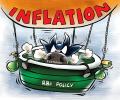
The RBI's Monetary Policy Committee brainstormed the impact of any future shocks on the inflation trajectory and stressed monitoring the cumulative effect of monetary policy actions over the past one year, which is still unfolding, revealed minutes of the rate-setting panel released on Thursday. The minutes of the meeting of the Monetary Policy Committee (MPC), headed by Reserve Bank Governor Shaktikanta Das, also indicated it would be premature to declare an end to the monetary tightening cycle, which started in May 2022 to check high inflation following the outbreak of the Russia-Ukraine war. The central bank, which effected six back-to-back hikes in the key short-term lending rate (repo) since May 2022 to check high inflation, decided to take a pause early this month.

Lenders are actively monitoring gold price volatility, prompting them to ask borrowers for additional gold collateral or partial principal repayment when loan-to-value (LTV) thresholds are breached, particularly for loans disbursed in February.

In an indication of further tightening of monetary policy, the Reserve Bank of India's (RBI) pre-policy report today said that managing inflation and inflationary expectations will be the dominant theme of monetary policy management in 2010-11.
